Services

How can we help your fleet?

Real results from tailored Fleet Driver Assessments

- Our Structured Approach

  • Step 1 – Driver Induction
    Establishes clear expectations, legal understanding, and safe working practices from day one.

  • Step 2 – Driver Assessment
    Evaluates real-world driving standards and identifies risk areas.

  • Step 3 – Targeted Training & Aftercare
    Supports continuous improvement following incidents or assessments.

fleet of vans with workers strolling
Your fleet matters
driver discussion inductions
Sharing findings

Step 1 - Driver Inductions

Driver inductions are the foundation of safe, compliant, and professional fleet driving.
At DriveSmart Solutions, inductions form Step 1 of our structured approach to improving driver standards and reducing risk across your fleet. Every induction is delivered through a detailed, personalised presentation, tailored to your vehicles, operating environment, and internal policies.

Each induction ensures drivers clearly understand their responsibilities and your expectations, including:

  • Driving law & legal responsibilities
    Current road traffic law, employer and driver responsibilities, and duty of care.

  • Driver safety & fitness to drive
    Fatigue management, medication, wellbeing, eyesight, and decision-making.

  • Seat belt use & legal requirements
    Legal obligations for drivers and passengers in all seating positions.

  • Distractions & driver behaviour
    Mobile phones, in-cab technology, cognitive distraction, and professional conduct.

  • Speed limits & vehicle-specific rules
    Speed limits relevant to different vehicle types within your fleet.

  • Vehicle checks & defect reporting
    Daily walk-around checks, defect identification, and reporting procedures.

  • Slow-speed manoeuvring
    Reversing, parking, site access, vulnerable road users, and vehicle positioning.

  • Vehicle technology & driver aids
    Safe and correct use of telematics, cameras, sensors, and in-vehicle systems without creating distraction.

  • Collision reporting & aftercare procedures
    What to do in the event of an incident, immediate actions, reporting requirements, and post-collision responsibilities.

  • Company-specific policies & standards
    Any additional rules, procedures, or expectations unique to your organisation.

Step 2 - Driver Assessments

Our on-road driver assessments are delivered in line with DVSA best practice, focusing on how drivers apply safe, legal, and professional behaviours in real-world conditions, not test-style performance.

Every assessment takes place in your own company vehicles, on your drivers’ normal routes and working environment. This means we see exactly how your drivers operate in the vans they use every day giving you accurate, relevant insight rather than a controlled snapshot.

What We Assess

– Speed Management – Selecting appropriate speeds for road, traffic, and weather conditions. Reducing speed progressively at junctions and hazards. Applying correct stopping distances and demonstrating safe decision-making in higher-risk situations.

– Safe Positioning – Maintaining safe clearance from parked vehicles. Using road position to manage space and reduce risk. Planning ahead to minimise reversing and maintaining safe following distances throughout.

– Hazard Awareness – Identifying developing hazards early and responding safely. Controlled slow-speed manoeuvring. Recognising risk when stopping on the road and adjusting driving plans before situations escalate.

– Visibility & Communication – Correct and timely use of mirrors and signals. Clear communication with other road users. Actively protecting vulnerable road users including pedestrians, cyclists, and motorcyclists.
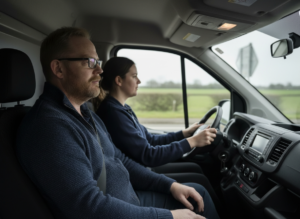
assessment image
Driver Assessment in van
fleet manager
Why This Matters to Your Business

A DriveSmart on-road assessment gives fleet managers the evidence and insight needed to:

  • Demonstrate proactive duty of care
  • Identify and address risk before incidents occur
  • Maintain consistent, defensible driving standards
  • Support driver development with targeted, meaningful feedback
  • Reduce collisions, vehicle downtime, and associated costs

Step 3 - Targeted Training & Aftercare

Assessment without action achieves nothing. Step 3 is where findings become measurable improvements closing the loop with clear reporting, structured feedback, and targeted support that drives real change across your fleet.

What Step 3 Includes

– Written Assessment Report – A detailed report issued following every assessment, suitable for driver files, management review, and audit records. Clear, structured, and defensible — exactly what fleet managers need to evidence due diligence and duty of care.

– Driver & Manager Debrief – A structured on-site feedback session with the driver, covering outcomes, findings, and agreed next steps. Where required, a separate review with the fleet manager ensures everyone is aligned and accountable.

– Targeted Training – Training focused specifically on the risk behaviours identified during assessment — not generic courses. Proportionate, relevant, and designed to reduce the likelihood and severity of future incidents.

– Follow-On Aftercare – Ongoing support where needed, including post-incident coaching, refresher sessions, or re-assessment. Supporting sustained improvement rather than one-off intervention.

reports
What This Delivers for Your Fleet
  • Reduced collision frequency and severity
  • Less vehicle damage and operational downtime
  • Stronger compliance and audit readiness
  • Consistent driving standards across your team
  • Clear, documented evidence of proactive risk management

Frequently Asked Questions

Got questions? You're not alone. Whether you're a fleet manager, operations lead, or business owner, these FAQs give you straight answers about how DriveSmart Solutions works, what we cover, and why it matters to your fleet.

🚐About Assessments +
Is an on-road assessment a driving test?
No. A DriveSmart assessment is not a driving test and has nothing to do with licensing. It is a professional, real-world review of how your drivers operate in their normal working environment. The goal is to identify risk, support development, and give you the evidence you need to manage your fleet properly.
Will my drivers feel judged or uncomfortable?
Our approach is calm, supportive, and non-confrontational. Drivers are not being caught out — they are being supported. Most drivers find the process straightforward and appreciate the structured feedback.
Where does the assessment take place?
Every assessment takes place in your own vehicles, on your drivers' normal routines. This gives us an accurate picture of real-world risk rather than a controlled snapshot.
How long does an assessment take?
Each full on-road driver assessment is part of a half-day session of up to 3.5 hours per driver. The assessment section is normally 2 hours. This allows sufficient time for proper observation, structured feedback, and meaningful reporting.
What happens after the assessment?
Every driver receives feedback on the assessment. Managers receive a clear summary of outcomes, risk ratings, and recommended actions. Where required, follow-on training or aftercare is offered as part of our structured three-step process.
🛡️Assessor Insurance & Liability +
Are you insured to be in our vehicles?
Yes. DriveSmart Solutions carries full professional indemnity and public liability insurance covering assessor activity in client vehicles. You are fully protected.
What happens if there is an incident during an assessment?
Your vehicle remains your responsibility and should be covered under your existing fleet insurance policy. Drivers remain legally responsible for the vehicle at all times during an assessment. DriveSmart Solutions carries its own professional liability cover for assessor activity. Our Driver Declaration & Consent form, signed before every session, clearly establishes this boundary.
Can you take control of the vehicle if needed?
In rare circumstances where a driver presents an immediate safety risk, our assessor may intervene and assume control of the vehicle solely to return it safely. This is clearly documented in our terms and is covered under our professional insurance.
💷Insurance Cost Benefits +
Can having driver assessments actually reduce our insurance premiums?
Yes — and the evidence is clear. Industry data shows that fleet insurance premiums can reduce by up to 10–20% where structured driver training and assessment programmes are in place. Insurers view documented, systematic assessment as direct evidence of proactive risk management, which reduces their exposure and yours. This of course depends on your insurance company.
What do insurers actually want to see?
Insurers don't just want to hear that you train your drivers. They want documented evidence. That means written assessment reports, risk ratings, records of follow-up actions, and evidence of post-incident aftercare. DriveSmart provides all of this as standard.
How does this help us at renewal?
When you approach renewal with a portfolio of structured assessments, written risk reports, and documented improvement actions, you are demonstrating to your insurer that your fleet is actively managed. That shifts the conversation from reactive claims history to proactive risk control — and that is what moves premiums.
Does one assessment make a difference?
A single assessment gives you a baseline and immediate evidence of due diligence. The real insurance and risk benefits compound over time as you build a documented history of consistent driver standards, ongoing assessments, and targeted interventions. That is exactly what our three-step process is designed to deliver.
📊The DriveSmart Client Portal +
What is the DriveSmart Client Portal?
The Client Portal is your dedicated, secure online hub where everything DriveSmart delivers for your fleet lives in one place. Assessment reports, driver risk ratings, follow-up actions, aftercare records — all accessible, organised, and ready when you need them.
Why does this matter to us as a fleet manager?
Because the moment something goes wrong — an incident, an audit, an insurance query, an HSE investigation — you need evidence fast. Not scattered emails, not paper files, not memory. The portal gives you instant access to a complete, documented record of every assessment, every outcome, and every action taken. That is what duty of care looks like in practice.
How does it support compliance and audit readiness?
Every document in your portal is dated, structured, and professionally formatted. If you are ever asked to evidence your approach to driver risk management — by an insurer, a client, a regulator, or a legal team — your portal is your answer. Clean, organised, and defensible.
Can we track driver improvement over time?
Yes. The portal allows you to see how individual drivers have progressed across multiple assessments, identify patterns across your fleet, and demonstrate measurable improvement. This is not just useful — it is exactly the kind of data that supports insurance negotiations and internal safety reviews.
Is it difficult to use?
Not at all. It is designed for busy fleet and operations managers, not IT specialists. Clean, straightforward, and accessible from any device.
What if we have multiple sites or a large fleet?
The portal scales with you. Whether you operate five vans from one site or fifty vehicles across multiple locations, your records are centralised, consistent, and always available.
Why should this matter to our business?
Because right now, most fleets either have no documented evidence of driver standards, or it is buried in spreadsheets and email chains nobody can find quickly. The DriveSmart portal changes that. It turns your assessment activity into a business asset — one that protects you legally, supports insurance conversations, and demonstrates to clients, regulators, and insurers that your fleet is professionally managed. It is the difference between saying your fleet is safe and being able to prove it.